Case study
From Generative AI Capability to a User-Facing Home Design Product
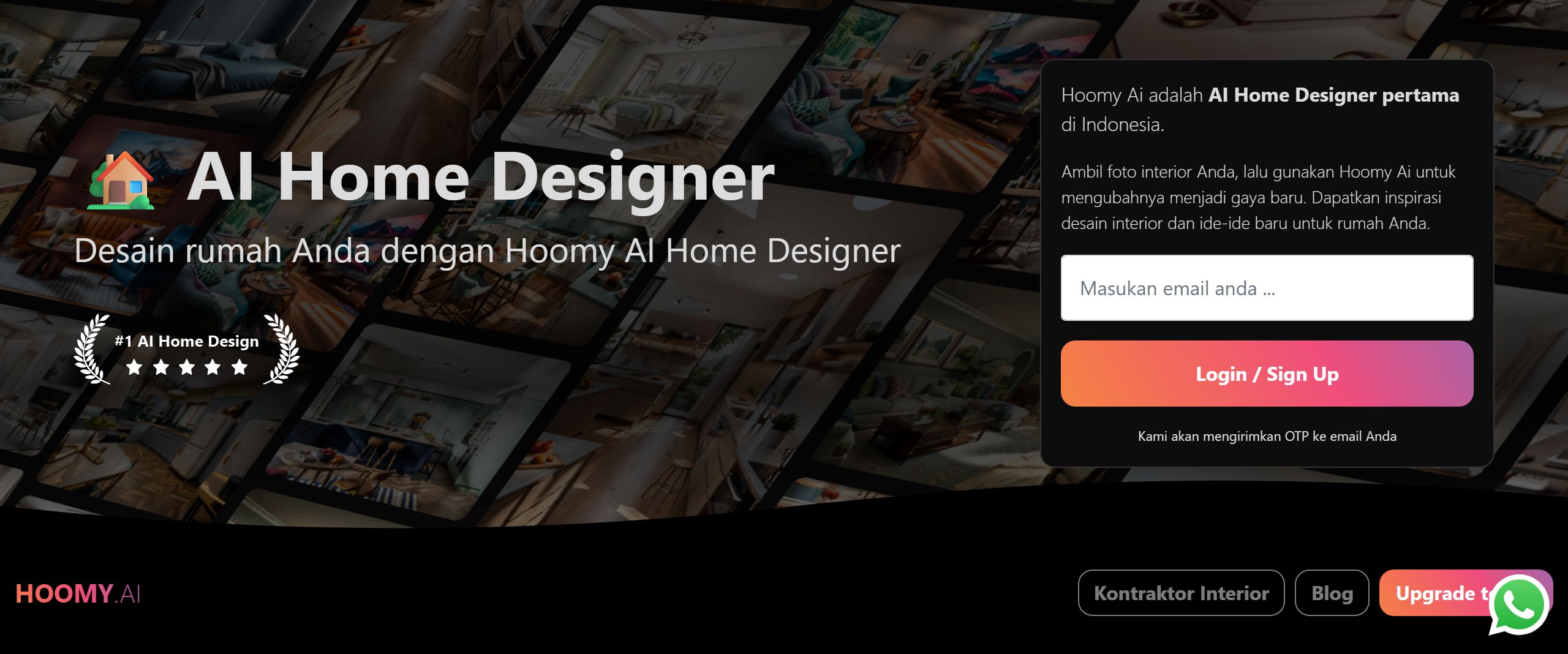
Hoomy AI is an AI-assisted home-design product that helps users explore alternative interior and exterior visual concepts for the Indonesian market.
Context
Hoomy AI applies generative AI to home design, giving users in the Indonesian market a way to explore interior and exterior concepts before committing to a design direction.
Problem
Turning a generative AI capability into a reliable, user-facing product raises questions well beyond the model itself: how input is processed, how prompts are designed, how the resulting image workflow performs, and how output quality is evaluated before it reaches a user.
My role
Developing an AI-assisted home-design product, covering the experience around a generative AI capability — from input processing and prompt design through to the resulting image workflow.
Engineering considerations
- Applied generative AI, productized into a user-facing design experience.
- Input processing and prompt design shaping the quality of generated concepts.
- Image workflow and output-quality evaluation before results reach the user.
- Latency and operational cost of generating images at product scale.
- Reliability of the generation pipeline in everyday use.
Security considerations
- Safe handling of user-submitted images.
Governance considerations
- Communicating the limits of generated results responsibly, so users understand what the AI output can and cannot represent.
Constraints & trade-offs
The product had to balance user experience against latency and operational cost — image generation needed to feel responsive without an unsustainable compute cost per request.
Outcome
A generative AI capability was shaped into a user-facing home-design product for the Indonesian market, giving users a practical way to explore design alternatives while keeping the AI's role and limits clearly communicated.
AI-generated designs from Hoomy AI are visual inspiration only. Any decision involving construction, safety, engineering, or regulatory requirements should be reviewed by a qualified professional before being acted on.
Specific operational metrics and internal implementation details are omitted to protect confidential information.